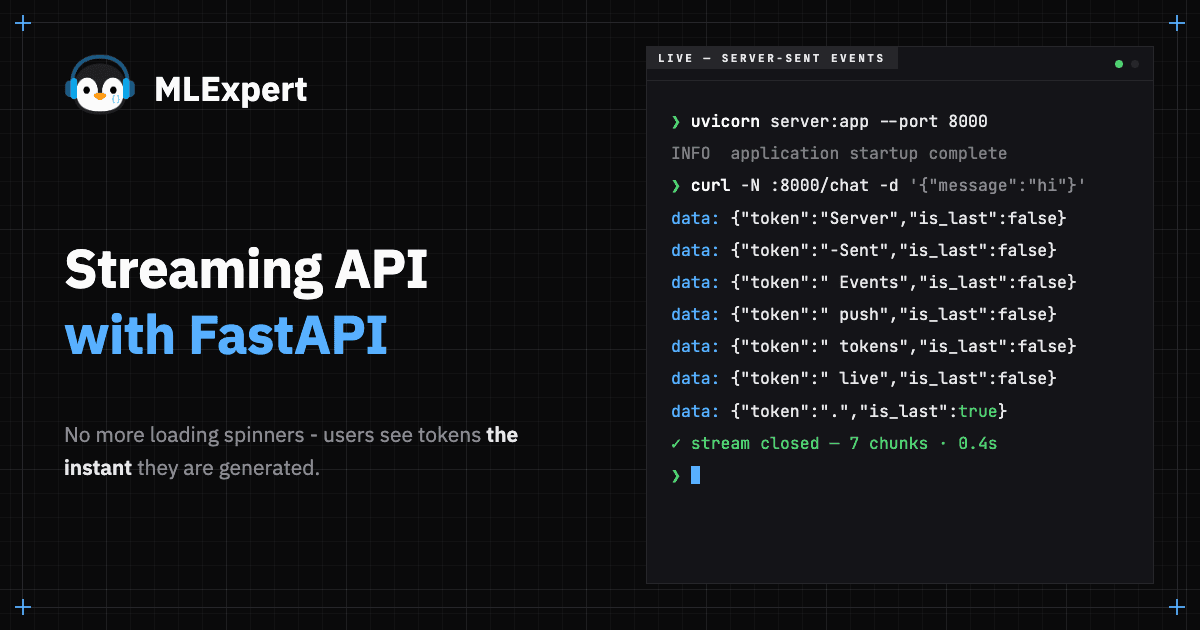
Streaming API with FastAPI
Move from local scripts to production-ready APIs. Learn to wrap your LangChain logic in a FastAPI service, enforce data schemas with Pydantic, and stream responses to clients using Server-Sent Events (SSE).
You have a working LangChain script that generates text and follows instructions. But right now, it is in a local Python file on your laptop.
To build a real product, you need to expose that logic with an API. And because LLMs can be slow, a standard "request-response" HTTP call won't cut it. Your users will leave if they stare at a loading spinner for 5+ seconds. You need Streaming.
In this tutorial, we will take the logic you built in the previous lesson and wrap it in a FastAPI1 service. We will enforce strict data contracts using Pydantic to protect your model from bad data, and we will implement Server-Sent Events (SSE)2 to push tokens to the client in real-time, drastically reducing perceived latency.
Tutorial Goals
- Wrap LangChain logic in a high-performance FastAPI backend
- Define rigid data contracts using Pydantic to reject malformed requests
- Implement Server-Sent Events (SSE) for real-time token streaming
- Understand Python generators vs standard functions
- Build an asynchronous Python client to consume the stream
Why FastAPI?
Members onlyJoin 900+ members
Become a member for full access
“Best educational investment in my ML/AI journey.”
Ana Clara MedeirosAI Developer
Renews yearly at the price you joined at. Cancel anytime.
30-day money-back guarantee. One email, full refund. Yearly includes live cohort access.
What you get
6 modules and 42 hands-on lessons with runnable code, failure diagnosis, and measured comparisons
2 capstone repositories you build, test, evaluate, and keep as portfolio proof
Videos, source code, complete projects and architecture diagrams
Recordings of live sessions
Discord community access
Not ready? Try these free lessons first
Instant access after paymentSecure checkout via Stripe